
An open-source silicone menstrual cup that seals before extraction, for menstruation in reduced gravity
Traditional menstrual management techniques cannot be used in a reduced gravity context as the blood is not pulled by gravity to fill a pad, cup or tampon. The SpaceCup is a reusable silicone cup with a mechanism that closes its opening before the cup is removed. Seven closing mechanisms were designed and six bench-tested; the two Flower designs scored highest (24/25), and Flower Low was flown. The presented cup is designed for reduced gravity but can also be used on Earth where the menstrual blood needs to be collected and extracted intact.
Every part is cast from 3D-printed moulds; the mould files, the editable CAD and the casting guide are all in the repository.
Background
Menstruation in space is currently managed mainly by hormonal suppression. On long missions that depends on drug storage, mission length that may change, and in some cases refrigeration. Tampons and pads create waste, whilst commercial menstrual cups rely on gravity.
A menstrual cup is reusable and holds fluid instead of absorbing it, but in microgravity surface tension and adhesion dominate how the fluid behaves, so a conventional open cup cannot be relied on to keep it inside during removal. The SpaceCup adds a closing mechanism that seals the opening first, operable one-handed with two fingers.
The work set out to answer three questions: which sealing mechanism, material and geometry give the best usability, manufacturability and anatomical fit; whether it contains fluid under reduced gravity; and how it can be cleaned where water is scarce. It builds on a base cup defined in a 2025 bachelor thesis of Simone Pfeiffer at the same group (wall 2 mm, rim outer diameter 41–44 mm, length 45–55 mm without stem, capacity 20–30 mL).
Closing mechanisms
Six closing mechanisms were designed, cast from silicon, and scored on the bench out of 25. Every mechanism closes the same base cup. The scores and the scale are under Validation. Parts that come from separate CAD files are shown side by side, not assembled. The eighth card, the extraction valve, is a later concept: designed, but not tested and not part of the thesis. The prototypes were cast in coloured silicone; in the renders, colour marks the role of a part (grey body, purple closing mechanism), not its material.
No prototype photo: the thin membranes could not be cast reliably.
No prototype photo: designed, not tested.
Selected prototype for the parabolic flight
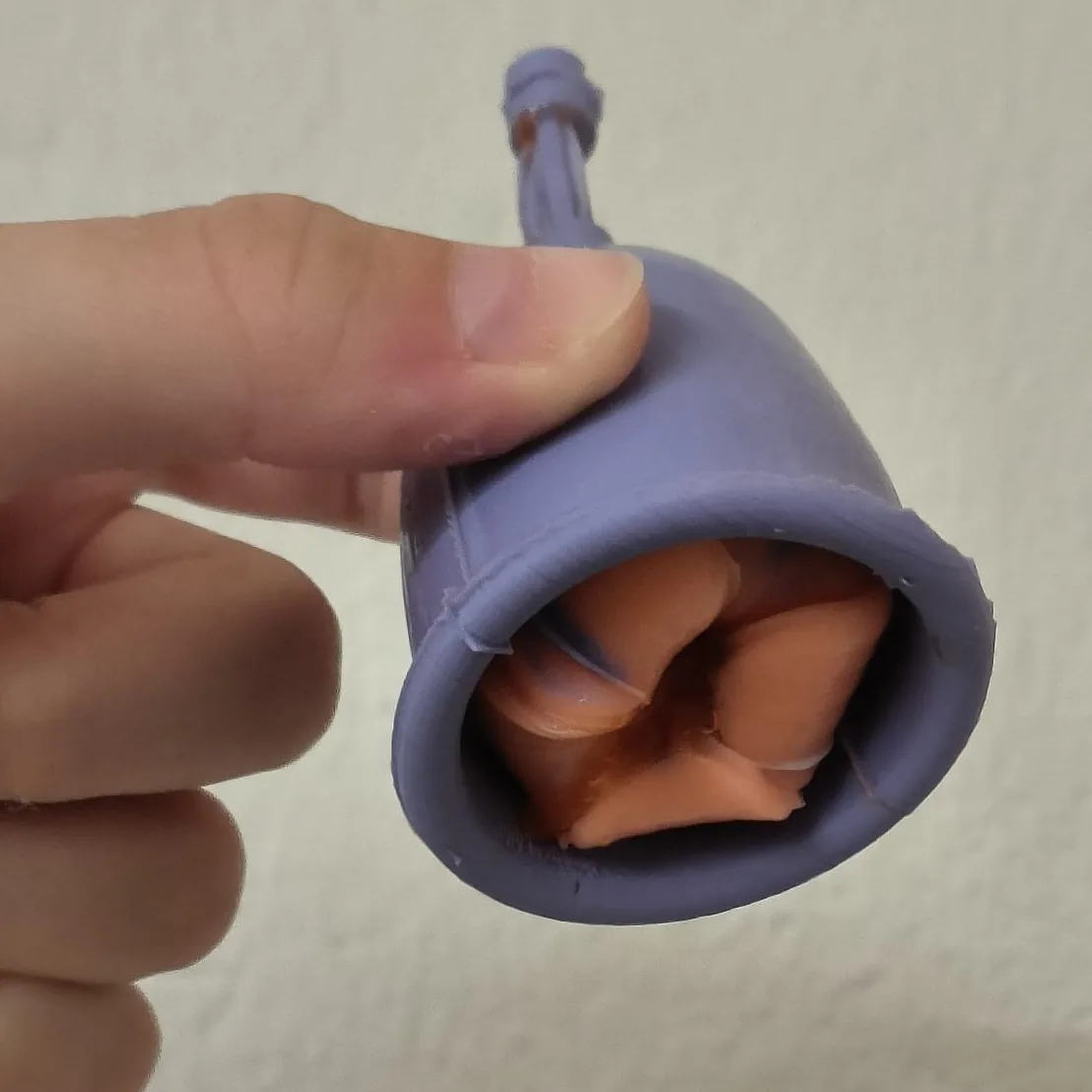
The prototype tested in the parabolic flight, referred here as "Flower Low", is a silicone cup with five flexible, petal-like elements around its opening. Each petal is joined by a silicone string to a pull mechanism in the stem; pulling it draws the petals together and closes the cup before it is removed. The renders show the strings straight, as cast. The cup follows the base-cup envelope: 2 mm wall, 41–44 mm rim, 45–55 mm long without the stem.
| Part | File (under hardware/) |
|---|---|
| Cup, Flower Low (6 solids: body halves, two small pieces at the stem end, petals and strings) | flower-low/step/flower-cup-withrim-part.step |
| Mould, 6 pieces | flower-low/step/flower-cup-withrim-mould.step |
| Mould, print-ready | flower-low/mould-stl/ (8 STL) |
| Cup and mould, whole-part meshes | flower-low/stl/ (4 STL) |
The source CAD is Siemens NX; every part ships as STEP, the editable format, plus a whole-part STL for viewing. See hardware/nx.md and hardware/README.md.
Printing the moulds and casting
Nothing about the cup is printed directly: the printer makes the moulds, and the cup is cast in silicone. The mould files for every variant are in the repository.
| Mould print setting | Value |
|---|---|
| Mould material | ASA for the 100 °C cure; PLA, PETG or ABS for room-temperature silicones |
| Layer height | 0.15–0.2 mm |
| Walls | 5 lines |
| Infill | 15 % |
| Vents | 2–3, about 0.5 mm |
| Alignment keys | 3 mm hemispherical |
Casting
- Print both mould halves (and any cores) from the variant’s mould-stl/ folder.
- Mix the two silicone parts at the ratio on the data sheet (do not assume 1:1) and degas under vacuum.
- Clamp the mould, inject the silicone through the sprue at the stem with a syringe, and close the vents with tape or wax once silicone appears.
- Cure as the data sheet specifies (see the table below), then open the mould and demould slowly to avoid tearing thin features.
- For sections of a different hardness, cut them out of the cured cup, refill with the other silicone and cure again.
Casting in practice
Silicones used
| Silicone | Maker | Used for | Cure |
|---|---|---|---|
| Smooth-Sil 945 | Smooth-On | cup body (prototypes) | 6 h |
| Rebound 25 | Smooth-On | flexible sections | |
| Smooth-Sil 960 | Smooth-On | rigid sections | |
| ELASTOSIL LR 5040/45 A/B | WACKER Chemie AG | medical-grade prototype (Flower Low) | about 2 h at 100 °C |
Medical-grade silicone does not make the prototype a certified medical device. Full procedure, known defects and fixes: docs/manufacturing.md and the author’s moulding guide (PDF).
Use and cleaning of the Flower designs
The handling steps below apply to the two Flower designs (Flower Low, flown, and Flower High), whose pull strings close the petals; the other mechanisms are operated differently and were not taken this far. The SpaceCup is a research prototype, not a certified medical device, and is not intended for personal use.
- Fold the cup, for example into a C shape, and insert it.
- To close, pull the strings at the stem steadily; pull only until the petals close, not so hard that the cup comes out.
- Remove the closed cup by the stem.
- Empty it with a syringe through the opening.
- Reset the Flower mechanism by pushing the tail back until the petals reopen.
- Clean: wipe off residue, then immerse and shake in 70 % isopropanol.
The cleaning study covered Flower Low, Flower High, Drawstring and Twister, plus a reference cup. Of the three cleaning methods tested, 70 % isopropanol with shaking left the fewest colonies. The narrow gaps between the Flower’s strings held residue that steam reached poorly. Results are under Validation; the procedure is in docs/use.md.
Validation
Six mechanisms were scored on the bench at 1 G, the Flower Low design was flown on the Asclepios VI parabolic flights, and four designs went through a cleaning study. The flight results are qualitative: no fluid volumes could be measured on board.
Bench scores
Each criterion scored 1 (not met) to 5 (fully met); containment volume held at 1 G in brackets; target 12 mL, 30 activation cycles.
| Mechanism | Sealing | Containment | Reliability | Usability | Manufacturing | Overall |
|---|---|---|---|---|---|---|
| Flower Low | 4 | 5 (18 mL) | 5 | 5 | 5 | 24/25 |
| Flower High | 5 | 5 (30 mL) | 5 | 4 | 5 | 24/25 |
| Duckbill | 3 | 5 (14 mL) | 5 | 5 | 4 | 22/25 |
| Twister | 5 | 5 (15 mL) | 5 | 2 | 4 | 21/25 |
| Drawstring | 1 | 5 (27 mL) | 5 | 4 | 3 | 18/25 |
| Umbrella | 4 | 5 (22 mL) | 1 | 3 | 3 | 16/25 |
Parabolic flight
Three analogue astronauts ran the Flower Low procedure in a glovebox over ~6 s reduced-gravity windows, with tampons as a comparison. Their post-flight answers (P1 to P3):
| Question | Answers (number of participants) |
|---|---|
| Overall experience | easy (1), difficult (1), very easy (1) |
| Containment | minor leakage (2); not observed (1) |
| Activation | easy (2), very easy (1) |
| Insertion | easy (2), moderate (1) |
| Extraction | very easy (2), easy (1) |
| Compared with a tampon | similar (2); not observed (1) |
| Procedure felt safe | yes (3) |
Cleaning
Colonies per plate after each method, from yoghurt contamination; "~" marks an estimate on a dense plate (±10–20 %).
| Method | Flower Low | Flower High | Drawstring | Twister | Reference cup |
|---|---|---|---|---|---|
| 70 % IPA | 5 | 12 | 1 | 1 | 0 |
| Microwave | ~54 | ~33 | 0 | 1 | 1 |
| Boiling | 9 | 10 | 15 | ~130 | ~53 |
Data and codebook: data/. Method details: docs/validation.md.
Limitations
The tests show that the Flower mechanism can be inserted, closed and removed during short periods of reduced gravity. They do not yet establish how well it contains fluid over long-duration use.
- Research prototype This is a proof of concept. It is not a certified medical device: further testing and validation would be needed, and every mechanism still has to be developed in medical-grade silicone.
- Parabolic flight testing The parabolic flights were, to our knowledge, the first time menstrual management was tested in a reduced gravity context, but each parabola lasted only about 6 s. Representing an astronaut wearing such a device calls for longer campaigns, which would also let the tampon (the reference device) and the SpaceCups collect more fluid in flight.
- Experimental set-up In flight the SpaceCups and tampons were inserted into a model vagina that does not accurately represent the female anatomy. It was also too opaque to track the behaviour of the menstrual blood adequately.